
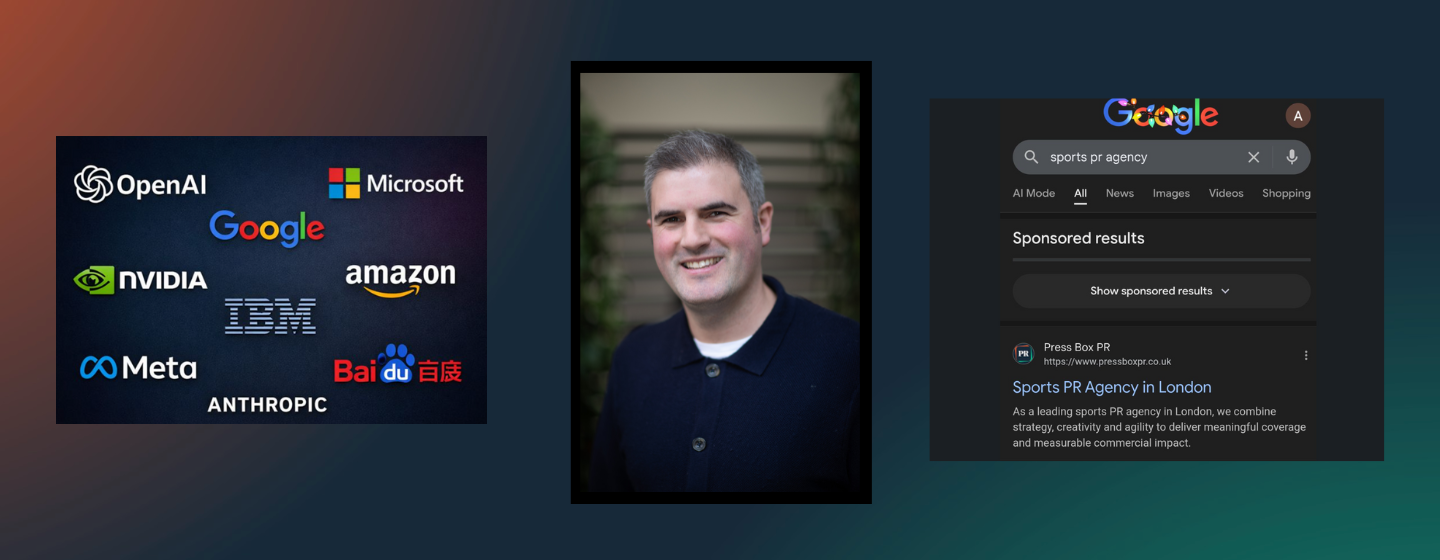

Why AI recommendations will define 2026 for digital brands
For years, brands have relied heavily on search rankings to drive digital visibility. Page one on Google was the golden goose. That strategy now faces serious disruption as people increasingly rely on AI to filter, shortlist and recommend for them. They are asking what is best, who they can trust, and what they should do next. With 2026 up on us, Alex Donohue, MD and founder of Press Box PR, shares his thoughts on what this means for brands preparing for this year’s biggest sporting events and their most commercially critical moments.
Traditional SEO helped people find answers. AI tools now point people to brands, not just answers. That is a fundamental change in how discovery works. Authority, trust and relevance now outweigh pure visibility. It is no longer enough to appear. Brands increasingly have to be recommended.
This is not a future problem. It is already shaping how people research products, services and suppliers. What makes 2026 different is scale. This year will be the first time this new behaviour reaches real commercial scale across major global events and regulated sectors. The competitive layer is moving from being visible to being credible.
Why traditional links and rankings are no longer enough
Links and keyword rankings remain essential foundations of digital discovery. But in isolation, they no longer create competitive separation. Many brands now operate in environments where the ability to stand out from the crowd can stem from fewer pieces of high quality media coverage over and above quantity.
AI systems do not rely on a single signal. They evaluate brands through a mix of trust indicators, including reputation, consistency, expert voice, recency, and contextual relevance. The good news for digital PR people is that it’s easy to see which sources the algorithms favour, but the harder part is the ability to influence them.
What now creates separation is whether AI systems, and the people behind them, treat a brand as a trusted source. Coverage volume matters less than consistency of expert voice, attribution, and reputation across trusted environments.
This doesn't mean traditional SEO becomes irrelevant but it means strategies must evolve. Brands that combine solid technical foundations with genuine authority and expert positioning will win.
Discovery is now driven more by reputation than by rankings alone. Brand mentions, expert commentary and narrative consistency increasingly outweigh raw domain metrics. Brands that chase links but neglect authority will lose visibility in recommendation environments where trust decides outcomes.
What AI recommendations now demand from brands and operators
To be recommended at scale, brands now have to meet a higher standard of authority. First-party data and original insight matter more than ever. Generic content that repeats what is already widely available adds no value in an era when AI summarises content at scale.
Expert analysis has to demonstrate real sector knowledge. Timely, well-judged commentary matters, especially when markets move quickly. Saying the same thing across your channels shows you can be relied on. Where regulation is tight and trust is fragile, transparency matters as much as accuracy. And in markets such as sports betting, AI recommendations become a credibility test as much as a visibility channel.
Education becomes visibility. Major global events, particularly the World Cup, introduce time-pressured and often inexperienced audiences. In regulated sectors, operators that explain risk clearly, guide responsibly, and communicate affordability and consumer protection well build trust that survives volatility.
Performance-led storytelling now matters more than promotional marketing. Long-term trust building replaces one-off activity. And crucially, content now has to satisfy both human judgement and AI evaluation. AI systems increasingly mirror what people already trust and treat as credible.
2026’s real-world test case: The World Cup and UK horse racing
This year turns AI recommendations from concept into a commercial reality. The FIFA World Cup will act as a global catalyst for behavioural change and betting volume. It will draw large numbers of time-pressured users seeking quick guidance, comparisons, and trusted information. A recent Spotlight Sports Group 2026 World Cup Betting Outlook found that 70% of fans plan to place a bet during the tournament, even though only 7% say they feel confident doing so.
UK horse racing provides the counterbalance. It is a year-round, high-frequency, heavily regulated environment where trust is earned slowly and lost quickly. It operates under constant scrutiny, with volatility driven by weather, liquidity shifts and regulatory oversight.
Together, these two environments provide a real-world test of performance and trust. Peaks of attention, volatility, regulatory exposure and reputational risk will all collide. It is during these moments that AI-powered search and recommendation tools will be used most heavily. Users will look for quick answers, but they will also seek reassurance and credibility.
If AI tools do not recommend a brand during these high-pressure windows, its visibility with the most commercially valuable audiences collapses, regardless of how strong its traditional rankings appear.
What success looks like in the AI recommendation era
Success is no longer defined only by traffic volumes or coverage counts. Being cited, summarised and surfaced by AI systems becomes a core visibility metric. Expert voice starts to carry more weight than sheer link volume.
Long-tail brand discovery becomes more valuable than short campaign spikes. Trust and authority must be visible across multiple platforms, not just search engines. Measurement shifts from coverage counts to credibility signals. Are AI systems citing you? Are journalists and analysts treating you as a source? Is your voice appearing in operator and industry research?
The brands that perform best in this environment will be those that understand discovery as an ongoing reputation system, not as a sequence of campaigns.
Why 2026 will separate visible brands from trusted brands
AI will increasingly sit between brands and the people discovering them. Recommendation becomes the new competitive space. Brands that invest in authority now will carry that trust forward. Brands that rely only on old visibility models will be seen less and less.
The World Cup and UK racing will be the first clear proof of this reality at scale. What happens in those environments will not stay confined to sport. It will shape how brands across all sectors understand the difference between being found and being trusted.


%20(1)_11zon.jpg)